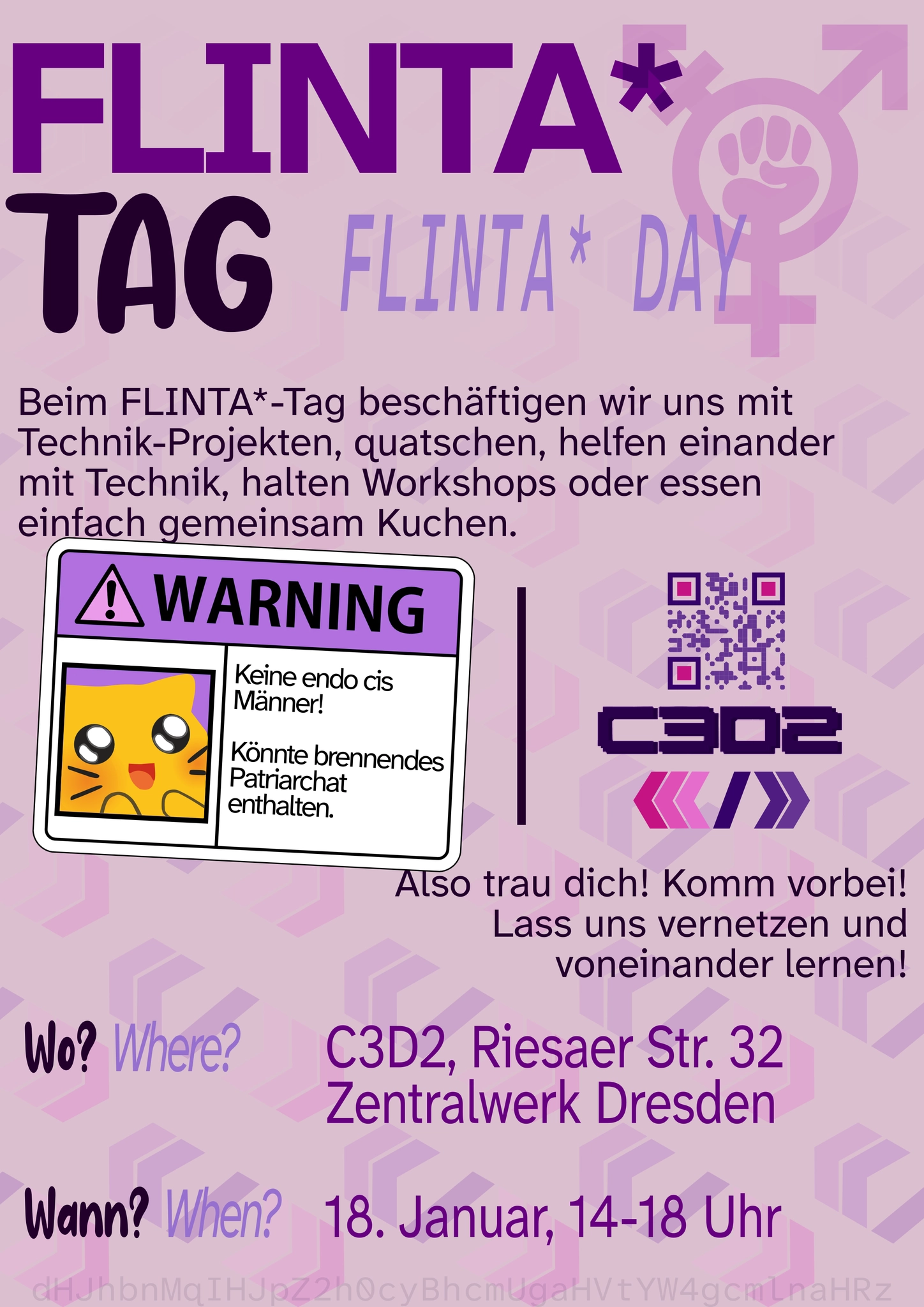
In 10 Tagen ist es wieder soweiiiiiit! Am 18.01.2026 schmeißen wir zwischen 14 und 18 Uhr alle endo cis Männer aus dem C3D2 Hackerspace und veranstalten den FLINTA-Tag (name change pending)! Es gibt keine übergeordnete Agenda; es geht einfach um ein nettes Vernetzen und Zusammenkommen von technikinteressierten FLINTA-Personen. Dabei ist im Wesentlichen nur wichtig, dass ihr interessiert seid, nicht, dass ihr Expert:innen seid. Kommt gern vorbei und helft dabei, unseren lokalen Hackerspace durch eure Anwesenheit schöner und diverser zu machen
@zenmaya well ig - name of event - place - time are the most important pieces of info. addresses are localized, inferring januar to be january shouldn't be a stunt and the i guess the time is also managable
@star@zenmaya It actually would not be the same acronym if translated into English, and it's not used in English either 😅 And how should one figure out what it might mean if one is not deeply into queer feminist terminology, even more so in a different language? I see people asking what "FLINTA" means all the time. So if it's used, I think it would be good to explain – for the audience it should address, for everyone it doesn't, for non (native) German speakers and to reduce ambiguity in general ^^ (Which is also one of the issues I have with the acronym)
@star@zenmaya sorry for being pedantic, but no – "Frau" is "woman" and "female" is "weiblich", those mean different things (even if they do coincide usually, in the gender binary) /lh
@fugi@zenmaya well, sorry for being even more pedantic, HOWEVER COMMA, the word "female" has multiple definitions, both in the dictionary and in common, everyday language use.
female (sex) does, indeed, translate to "weiblich". female (tech) usually refers to the hollow counterpart of a connector. it'd be silly to assume that it'd mean anything other gender related, although, obviously, the word has its meaning from an (outdated, as we all are painfully aware) sex-based definition. female (animal) would most likely translate to something like "Weibchen".
and, last but not least, female (woman) is also a correct and apparently frequently used way to translate "Frau".
@star tho I would have probably missed it if you didn't say so :/ none of the iOS clients seem to support it (for getting notified at least), I might have to do some frickeling
@star@fugi i saw it as "femme" which feels much better tbh, buuuut, also it goes right to the issues i have with flinta, like what about gnc people who identify as men
which are plenty, i just didnt want to go into that discussion
@star@zenmaya Not if they identify as a man. If a person is a cis endo man, and gnc, they would not fall under FLINTA, strictly speaking. Whether that is the intention (of e.g. event organizers) would be a question worth asking. IMO it leads to the conclusion that FLINTA is not a very useful term to use.
@fugi@zenmaya hm. i think this reasoning dissatisfies me, because the reasoning that "it is very loosely defined and therefore likely not a useful term" (if that was what you were trying to say) can be applied to lots of things: "lesbian" for example. i mean, you could likely write an entire book about the discussions about the term, and where its inclusivity begins or ends. "heterosexual" is also defined extremely weirdly throughout the world, but has better definitions in queer circles. but i would not say that these terms aren't useful. we give them meaning through context and our own experiences and conversational intentions. words are just made up
@star@zenmaya the problem is that there is this much potential for arguing about what is included in FLINTA or not, at all. And in reality people will just assume wildly different things, e.g. like we witnessed at Datenspuren
@star@zenmaya Yeah but, not everyone can do that at all times. And people are lazy. If they weren't, there wouldn't be questions what it means, all the time (even on the internet) ^^ /lh




 Am 18.01.2026 schmeißen wir zwischen 14 und 18 Uhr alle endo cis Männer aus dem C3D2 Hackerspace und veranstalten den
  FLINTA-Tag
 (name change pending

 1
1



 1
1 1
1 1
1